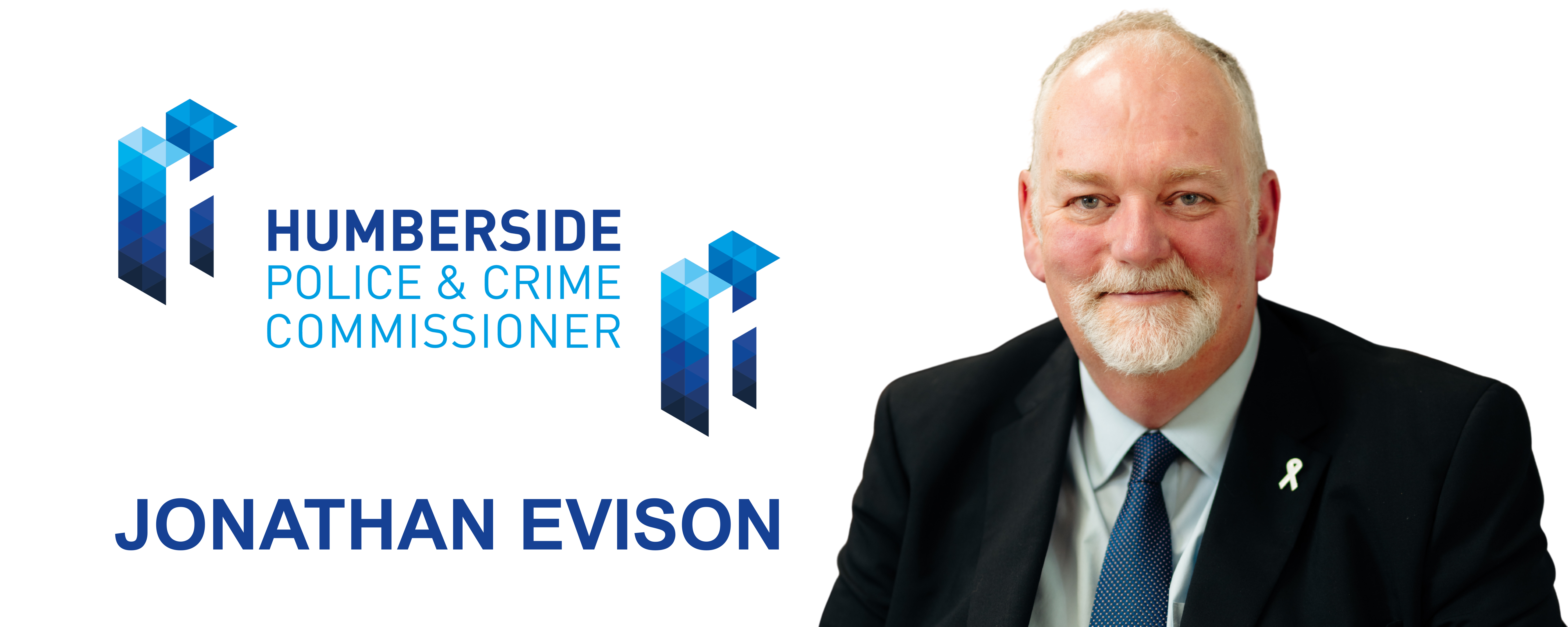
Humberside Police and Crime Commissioner Jonathan Evison has warned bigger police force areas will not automatically mean better policing following proposals to drastically reduce the number of forces in England and Wales.
Responding to a speech from Metropolitan Police Commissioner Sir Mark Rowley calling for eight to ten regional police forces to replace the existing 43, Mr Evison said the best interests of communities should take the highest priority in reform proposals.
Acknowledging the need to modernise policing and establish stronger national capabilities, Mr Evison said local leadership, accountability and a strong connection between policing and communities must be maintained through any changes.
“I want to see a modern, properly resourced and effective policing system that is capable of responding to the threats of the future,” he said.
“I support the creation of a National Police Service to support our local forces and bolster regional policing. I support stronger regional collaboration. I support better use of technology, shared specialist capabilities, improved national standards and greater consistency in the service the public receive.
“But I also believe strongly that local policing needs local leadership.
“We have spent ten years rebuilding Humberside Police and restoring the confidence of our communities. We have demonstrated that a force can turn around its performance through better leadership, stronger oversight and a clear commitment to local people.
“We should be building on that success, not putting it at risk.
“The test of any policing reform must be whether it delivers safer communities, better outcomes for victims, stronger neighbourhood policing and greater public confidence.
“If we can achieve those things through a stronger national service and building on the effective regional collaboration we already demonstrate while retaining effective local forces, that is the model we should pursue.
“People do not measure the success of policing by the size of the organisation or the number of headquarters it has. They measure it by whether someone comes when they call, whether their crime is investigated, whether offenders are brought to justice and whether they feel safe in their communities.
“That is what must guide every decision about the future of policing.”
The Commissioner’s position is reinforced by the findings of his 2026 public survey which attracted more than 2,300 responses from people across the Humberside Police force area.
A clear majority of respondents to the survey voiced concerns about the consequences of merging forces and a preference for retaining local policing.
Mr Evison said: “This substantial body of local feedback should give policymakers real pause for thought.
“People are telling us that local knowledge matters and it certainly matters in a region such as ours with such diverse needs and demands.
“Policing the East Riding’s villages and coast, the communities of northern Lincolnshire and the neighbourhoods of Hull requires in-depth understanding of circumstances, driven by local relationships and leadership that knows how to respond.
“We must not create a system where communities are increasingly distant from those making decisions about their policing.”
Mr Evison also pointed to the performance of Humberside Police as evidence that a medium-sized force can deliver strong results.
The latest HMICFRS inspection showed Humberside Police achieved a positive outcome rate of 18 per cent for victim-based crime, compared to a national average of 12.2 per cent
“These results are a demonstration that size is not a substitute for quality,” Mr Evison said. “The ability to deliver good policing is fundamentally about leadership, culture, effective management and understanding what communities need.
“There are much larger forces than Humberside which continue to experience significant challenges in investigative performance.
“Though not universal, previous HMICFRS results show larger forces have historically suffered from systemic operational weaknesses, cultural problems and resistance to change, with some placed in special measures or enhanced monitoring due to failures in basic duties such as answering 999 calls and investigating crime promptly.
“We should be asking what does and does not work and how we spread good practice rather than assuming combining organisations will resolve underlying problems.”
The transformation of Humberside Police in the last decade was also highlighted by the Commissioner as an example of effective local leadership.
He said: “Ten years ago, Humberside was one of the poorest performing forces in the country with serious problems that required intervention, difficult decisions and a fundamental change in leadership and culture.
“We needed to get leadership right, strengthen scrutiny, restore local accountability and put the needs of communities and victims back at the centre of everything we did.
“By 2019, the force was achieving Good ratings across all HMICFRS inspection areas for the first time in its history. By 2022, it achieved six Outstanding ratings.
“This transformation demonstrates what can be achieved when you have the right people leading an organisation, clear expectations and effective oversight.
“If there is one lesson I would offer those discussing the future of policing, it is that leadership quality needs to be strengthened across the board. We should be spreading the leadership and organisational practices that have delivered improvement.
“We should be fixing the problems we have, not assuming that a bigger organisation will fix them for us.”
He also warned the Humber must not lose out in a regional model where specialist resources are increasingly concentrated around larger metropolitan areas.
“Any new national or regional arrangements must recognise that smaller and medium-sized forces have an equal stake in the resources available,” Mr Evison said.
“We must not end up in a situation where the needs of Hull, East Riding, North Lincolnshire and North East Lincolnshire are competing unsuccessfully with the much larger demands of metropolitan centres.”
The Commissioner reiterated his longstanding position that mayoral boundaries in the Humber should be changed to be aligned with the establishing policing boundaries. His stance has been backed up by his public survey which saw retaining the existing Humberside Police boundary as the most popular choice for respondents.
Mr Evison said: “We should be looking at whether the boundaries of our new mayoral authorities can be made to work with the established policing geography, rather than dismantling a police force that has developed its own operational identity, relationships and understanding of local communities.
“Splitting Humberside Police to match the current mayoral boundaries would effectively divide our existing force area between two mayoral structures, creating unnecessary disruption and risk weakening the local relationships and accountability we should be protecting.”